Signed in
filler@godaddy.com

Growing Independence Through Purposeful Work
The toddler years are a remarkable period of movement, language, discovery, and growing independence. In our Montessori Toddler community, children are welcomed into a carefully prepared environment where they can make meaningful choices, participate in everyday routines, and develop confidence through purposeful activity.
Child-sized furniture, accessible materials, practical life experiences, and an orderly classroom allow children to practice doing more for themselves. Educators observe closely, offer clear and respectful guidance, and provide the time children need to repeat, concentrate, solve problems, and experience the joy of accomplishment.
Bellevue and Kirkland Campuses: 18–36 months
Children participate in dressing, handwashing, food preparation, cleaning, and care of the environment, building confidence through real and meaningful work.
Conversations, stories, songs, classified language materials, and everyday experiences help children expand vocabulary and communicate their thoughts and needs.
Carefully designed activities support balance, coordination, fine-motor control, and the growing ability to move thoughtfully within a shared environment.
Toddlers are driven by a powerful need to move, communicate, explore, and become increasingly independent. The Montessori environment responds to these sensitive periods with purposeful activities, clear limits, consistent routines, and opportunities for meaningful repetition.
Children practice dressing, washing hands, eating independently, preparing simple foods, and caring for personal belongings. Each experience strengthens confidence and the growing belief: “I can do it myself.”
Rich conversations, songs, stories, real objects, and classified language materials help children rapidly expand their vocabulary. Educators model clear language and support children in expressing needs, ideas, and emotions.
Walking, carrying, pouring, transferring, climbing, and manipulating small objects refine both gross- and fine-motor coordination. Children learn to move with increasing control and awareness of others.
Purposeful materials invite children to match, sort, sequence, problem-solve, and recognize relationships. Predictable routines and an orderly environment help children organize their experiences and develop concentration.
Toddlers begin participating in a community while still developing control over strong emotions and impulses. Educators offer calm guidance, consistent boundaries, and language for emotions, helping children gradually learn to wait, cooperate, and care for others.
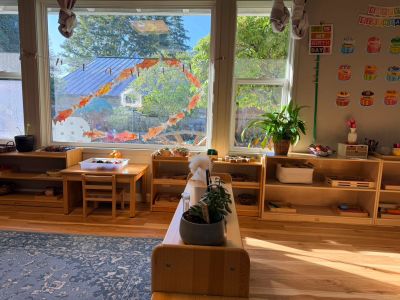
The Toddler classroom is carefully arranged so children can participate with increasing independence. Low, open shelves display a limited selection of purposeful materials, while child-sized tables, chairs, sinks, and self-care areas allow children to move through daily routines with greater confidence.
Practical life, language, movement, art, and sensory experiences are organized clearly and placed within the child’s reach. Children may choose an activity, carry it to a workspace, complete it through repetition, and return it to its proper place. This sequence supports concentration, coordination, memory, and a growing sense of order.
Materials and activities are adjusted as the children’s abilities and interests develop. Beauty, simplicity, and consistency help create a peaceful community where toddlers can make meaningful choices, care for their surroundings, and experience themselves as capable contributors.

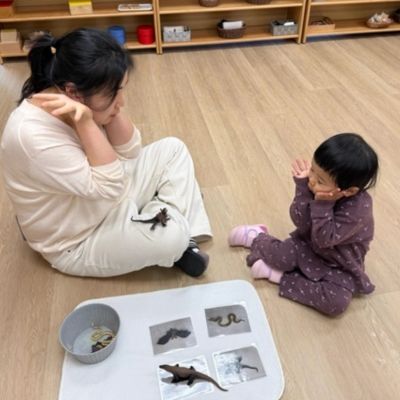
Toddler educators carefully observe each child’s interests, abilities, communication, and readiness before introducing new activities. Lessons are presented slowly and clearly, using precise movements and minimal language so children can focus, understand, and later repeat the work independently.
Educators offer limited, meaningful choices and provide help only when it is needed. Children are given time to try, make mistakes, solve problems, and complete tasks for themselves, allowing confidence and perseverance to develop through real experience.
Within the classroom community, educators model respectful communication, grace and courtesy, and care for others. Calm, consistent boundaries help toddlers feel secure while they gradually learn to manage strong emotions, navigate social interactions, and exercise freedom with responsibility.
Each day balances independent work, movement, social connection, personal care, outdoor experiences, meals, and rest. A familiar rhythm helps toddlers feel secure while allowing flexibility for individual development and needs.
ARRIVAL AND MORNING ROUTINES
Children are welcomed individually and begin the day by placing their belongings away, greeting their teachers, and transitioning into the classroom routine with growing independence.
MONTESSORI WORK CYCLE
During an uninterrupted work period, children choose activities from the prepared environment, receive individual or small-group lessons, repeat work, and practice returning materials to their proper place.
COMMUNITY EXPERIENCES
Songs, stories, music, movement, and brief group gatherings provide opportunities to build language, share experiences, and develop a sense of belonging within the classroom community.
MEALS AND SELF-CARE
Children participate in preparing the eating space, serving or feeding themselves when appropriate, cleaning up, washing hands, dressing, and toileting routines. These everyday experiences are essential parts of the Montessori curriculum.
OUTDOOR PLAY AND REST
Daily outdoor time supports large-motor development, exploration, and connection with nature. After lunch, children are supported through a calm and predictable transition into rest.
Throughout the day, educators protect children’s time to concentrate while providing the connection, guidance, and consistency toddlers need.
PARTNERING WITH FAMILIES
Close partnership with families helps toddlers feel secure as they navigate rapid growth and change. Educators and families share observations about separation, language, sleep, eating, toileting, emotions, and emerging independence to provide consistent and respectful support.
As children prepare for Primary, families and educators consider the whole child—not age alone—to support a gradual and positive transition.
Experience a classroom where children choose purposeful work, practice everyday skills, and discover what they can do for themselves.
Copyright © 2026 Avocado Montessori Academy
We use cookies to analyze website traffic and optimize your website experience. By accepting our use of cookies, your data will be aggregated with all other user data.